Monday, November 06, 2006

A Day In Our Life Over There - An Inconsequential Poem


We travel oddly, my son and I.
Pick country, cheap airfare, and rent-a-car.
EZ Pack: one for wash, wear, spare. Mostly.
Direction? Clockwise or not, depending.
Lost again? He decides. Elbows cross.
Fingers point both directions and we go.
No goals, nocall-aheads, hardly. Schmooze.
Find: Standing stones. Vikings. Crusades.
Castles. Family graves. Silent loud stories.
Rules: Ferry sign? Take it. Orkney, 5 A.M.
Sing the towns in songs. Fair Citee. Gra- nah-dah!
Volcano up close. El Greco hands. Bulls run.
Menu mystery: Pick the sixth. Bulls' ears?
And here lies the heart of Robert the Bruce.
Where is the rest? Fill in the gaps.
Personal best: Watch one parent, one child,
Now two adults. Joint venture.
Up-looking re-education with my Down son
Who is always Up. Hey, man. Who are we?
We are the Car-Dan Tour Company.
We master airports.
Thinking in the car.
Log on lap. Pencil.
My line of work ill-chosen for my kind.
A maze, unknowable turnings
With no-one at rest. Waiting for an outcome
From choices made, or found in the wood.
Who chose?
You get away, you think back.
Like after the push
When I went down the street.
Intentionally thrust
By the alien children
Abrupt, when I was four, and new
In the neighborhood.
Thought that long forgotten.
Right off the concrete stairs
Of the new addition.
They were silent after.
And my fingers sticky red running home.
The pitch. Again, there. Loud in its waiting.
The tolling. Ears ring ever after.
The mirror and the office.
Where the place.
All turnings. The mosaic reheaves.
Prom ball. Worldwide.
A technicolor ferris.
Fine ride. Next flight.


More blogs about Common Thread Road Ways.

Friday, November 03, 2006

Myths and Legends Sites - and Connections between Cultures

Reading myths can occupy an entire morning, at least, so do set aside the tme. We see statues of ancient gods and goddesses, references in the country's lore. Try this site before you leave for a country, to get a flavor of the old days - www.mythinglinks.org/euro%7Eeast%7EBalkans%7ERomania.

I especially enjoyed the sections with Romania and Central Europe, but just go to the home page (mythinglinks.org) for the best overall starting point. I am interested in the tree image that cultures use in creation stories and other purposes.

Sunday, September 24, 2006

Wars and War Crimes; Propaganda Techniques, And What Lack of Transparency Engenders


Here is Hitler's famous stadium in Nuremberg. See Germany Road Ways. The Nazi Documentation Center there is worth an entire day, if not more. Films, resources, guided seatings and transitions given for exhibits to alter your whole worldview. Things we don't want to acknowledge.

All over Europe are memorials and ruins remaining, statues and other strong reminders of conflict. From that, stems an interest in how governments get people to believe what the government wants them to believe, so the people will support them, and think they are making up their own minds. Not.

An overview of the techniques used to get people to support a cause, see www.propagandacritic.com/. Scroll to the Institute for Propaganda Analysis. Set up in 1937 by our own government to educate us about such techniques, so we could protect ourselves, and before WWII even. Whether the cause is a good one or not, it is the fact that there are known techniques that is more important. We should be self-educating, so we can analyze before swallowing. Who else will do it? Not the persuaders, certainly.

For an overview of the overall war crimes topic, see www.grolier.com/wwii/wwii_warcrimes. The issue comes up in the world wars and the countries involved. Not all agree on who should be tarred and tried as a war criminal. In Bosnia, posters protest against the ongoing search for some people, while trials of others continue at The Hague. Evildoing: Many-sided issue.

Good site for WWI picture history: www.historypictures.com/home_wcppx_l.htm#contents.

This site seems to have it all - news, poetry, songs, and histories and audios: www.firstworldwar.com/index. For military history overviews, various campaigns, see www.militaryhistoryonline.com/wwii/articles/anzio. There are also sites where vets can add their recollections.

Good picture history at Western Civilization Picture Pack, WWII at www.historypictures.com/home_wcppx_n.htm#contents. As with any of these references, go to the home page at the dot com, then use the rest of the address only as needed.
................................................................................................................................................
Where to put people's views of "wars" propagated on us from within, or close to?
Or that show how, without governmental transparency, conclusions of what happened are easily skewed?
Why aren't all the counter-footages, or black boxes, or whatever, showing the areas that now are still withheld, put out there?
  • Take your pick here, if you are inclined. These are long, so if you are going to delve in, set the time aside. Let me know of counter-sites that lay issues to rest for you.
  • These sites came from a comment on a blog. I did not publish the entire comment.
  • The sites here to films about these issues, of governmental transparency and remaining questions, are offered only to show a tally of what information is seen as most important by the film-makers, and do not represent a conclusion of the "best" or "right" ones because I am no expert. And, any film reflects the point of view of the film-maker. Do let me know of other film views we all should see for balance before coming to conclusions.

Controlled demolition? See video.google.com/videoplay?docid=-6708190071483512003;
related movements at video.google.com/videoplay?docid=-5948263607579389947; or
www.scholarsfor911truth.org/. Keep info, ideas flowing.
Already responses: As to 91truth, see a counter-site at 911research.wtc7.net/essays/st911/index.

Friday, September 22, 2006

Amnesia , Persuasion Techniques - and Lili Marlene (Lilli Marleen)

A side mini-rant.

Amnesia is the persuader's friend, all over the world. Represent what happened in a way to elicit certain emotions, perhaps change words, repeat, associate this with that, and people forget what was before, or the other side of the story.

This, in Cetinje, Montenegro. See Montenegro Road Ways.

Is there any country where critical thinking is encouraged, questions are solicited, to fill in details, or where visual and aural persuasion techniques are taught so people can defend against them? Or are persuasion techniques now used everywhere against them. Whether looking at war criminal posters in Bosnia, or seeing war memorials all over, or hearing political rally speakers and people rev up, or hearing war touted again as an answer, we may be at this point, all of us: we have to educate ourselves.

Look up the persuasion techniques listed from 1937 - now being used, at www.propagandacritic.com; and the great prophet of PR, he who could even "warm up" Calvin Coolidge - Edward Bernays from 1928 or so - see the Museum of Public Relations at http://www.prmuseum.com/bernays/bernays_1928.html,
You, too, can do it. Sell. Regardless. See www.aboutpublicrelations.net/. We deserve what we let happen.

Propaganda on a small scale: Lili Marlene. The torch song associated with World War II, both sides singing, hearing Marlene Dietrich's froggy voice, imagining the lamp post in Berlin.

This started with a protest poem by a German soldier in World War I - 1913 - on the way to the Russian front. See www.jazzprofessional.com/report/Norbert%20Schultze.htm#english. That site says that Ron Simmonds (the jazz trumpet player I think) translated the original from 1913. From the words to Lili, perhaps his girlfriend, and the Marleen maybe a nurse, Lili Marleen came about and herself may be already dead in that song. The waste of War. The blood. Who counts the bodies. Who names them. All from pride and greed. That is 1913. Lili Marleen.

But then, the song morphed into its opposite - a torch song in wartime in World War II, and even a Panzer Division marching song. See Germany Road Ways, Lili Marleen post.

So somehow war is not protested in Lili Marlene. It is just a love song. Go to the Germany Road Ways, Lili Marleen post and you can find the audio of the song, in its many variations, and the poem. Small example, but we can't seem to look at truth for long. War protest, too powerful, So turn it into nostalgia for war.

Monday, September 18, 2006

Historical periods, survey sites, UNESCO World Heritage

1. UNESCO World Heritage sites. See http://www.galenfrysinger.com/world_heritage.htm for World Heritage sites he has visited; then roam about his pages for photos all over the world - and organized, sometimes, into other categories than mere countries - the Roman World, for example. Also: UNESCO World Heritage sites: United Kingdom www.thesalmons.org/lynn/wh-england.

2. History.

2.1 Feudal societies, Roman Empire, overview of European migrations and those affecting Europe: see the History of Central Europe at //mysite.du.edu/~etuttle/misc/europe.htm#Mong.

2.2 Sites with different perspectives on history: This site says that our esteemed idea of Renaissance in the 15th century was nothing. Instead, look at the 12th Century. Names names. For an unusual topic, "The Renaissance Myth," see web.maths.unsw.edu.au/%7Ejim/renaissance. There are always new ways of sorting information.

2.3 Overall, for history go to the Internet History Sourcebook site at www.fordham.edu/halsall/. It includes film, everything you could want. You get lost in it, going from one link to another. I used the top menu rather than the side one.

2.4 Middle Ages: try www.ship.edu/%7Ecgboeree/middleages.

2.5 Surveys and commentaries: www.eyewitnesstohistory.com/. See ancient world, voices, photos, Queen Victoria, the death of a child in 1890, and a red light district in 1843, and other focused (not just survey) topics; see also the World Association of International Studies on history at cgi.stanford.edu/group/wais/cgi-bin/index.php?p=587">WAIS on history. These are a series of brief commentaries.

3. Country-specific themes: English towns: see www.trytel.com/%7Etristan/towns/towns. [others are also listed, not in England; and other topics such as plague}

Electric Scotland: www.electricscotland.com/history/journey/jour21.


4. Where to go: Internet "hotlist" on middle ages: www.kn.att.com/wired/fil/pages/listthemiddel.

5. Myths - Forest myths around the world: at www.leaf-international.org/Leaf/myths.

6. Monasticism - at aggreen.net/monasteries/monastic.

Saturday, September 09, 2006

Belfries and Keeps; Trees on roofs


See this World Heritage site for the role of belfries and keeps in medieval life. The belfry signified independence, the keep signified the power of the overlord, as a summary - and there are apparently 23 of them that are especially beautiful in France and Belgium. See whc.unesco.org/en/list/943 for Keeps and Belfries. We began sketching the different types - witches' hats, onion domes.

Tree-topping for luck. Here is an example of "tree-topping" at Prislop, the Gateway Pass, Romania. This U.S. site says the custom of "tree-topping" is Scandinavian, dating from the Vikings. See www.austinchronicle.com/gyrobase/Issue/story?oid=oid%3A225315%20">Trees on Rooftops. If the long address does not work to get yo to the specific section, start with the main dot-com and work your way. The site notes that ironworkers these days may all sign the beam before putting them in place. Then they often put it up with a flag and evergreen tree on it. The tree idea goes back to Scandinavians, Vikings, symbolizing work done well, and promoting good luck for those about to move in. It was American Norwegian ironworkers who added the American flag iere, putting their own touch on the tradition.

For steelworkers, it also signifies, says this next site, that the maximum height has been reached, and the last beam is now in place. And, it notes that the Scandinavians by 700 A.D. used the tree at the top to signal the beginning of the "completion party." Everybody come. See www.aisc.org/Content/ContentGroups/Modern_Steel_Construction3/December_2000/0012_05_christmas.pdf#search=%22luck%20tree%20on%20roof%22. That is a pdf file, at page 1 of 4. Go to the basic aisc.org if the later information does not help.

So much easier if we could link, and if the protections of copyright and intellectual property could still be offered.

In Romania, the trees are also found on reconstructions and on tops of gates leading to a family compound.

A Japanese site also seems to say that cut trees at the entrance are lucky. See www.hkjapaneseclub.org/english/message. Quote from that site: "Good Luck Tree.
We placed two good luck trees on our 38/F & 39/F at the main entrance. Member can hang your wish on the tree. It will all come truth!" Unquote.

Tuesday, August 01, 2006

Sheelanagigs, in cultures closer to nature


The Normans are also known as Northmen, the Vikings.

Among their conquest achievements is their invasion of England from Normandy, the area of France given to them to keep them from plundering up the Seine any longer. And, from England and Wales, on to Ireland.

After conversion to Christianity, the Normans built churches with distinguishing characteristics, see www.historylearningsite.co.uk/medieval_church_architecture; and www.mondes-normands.caen.fr/angleterre/cultures/GB_FR/culture6_3.

The Normans built their churches wherever they went - see, for example, in Sicily, in the crusades era. See the Monreale post at Sicily Road Ways.

On many in the British Isles, you also will find - if your eyes will tell your brain, and your brain will let it through -- that there are unclothed forms on Norman churches. These are called sheelanagigs, and they can be either gender. They may be up high, as the first one we found at St. Clement's, Rodel, Harris, the Hebrides. The sheelanagig there is midway up the tower, and quite small, but intentionally placed on a course there. See Hebrides Road Ways

Some explanations say they are fertility symbols, some say they stem from old Celtic forms, as at crossroads or patted for luck or for children; others have no explanation. How they look: Some are dignified, some are exhibitionist, some are hag-ish, others are quite lovely. Here is a closeup of the one here at St. Clement's. Do visit this site for long descriptions and many pictures of sheelanagigs. www.sheelanagig.org.

Biography - Following People, Real or Fictional, and Songs

Here is a good overall biography resource: //www.biographybase.com/bio/a.

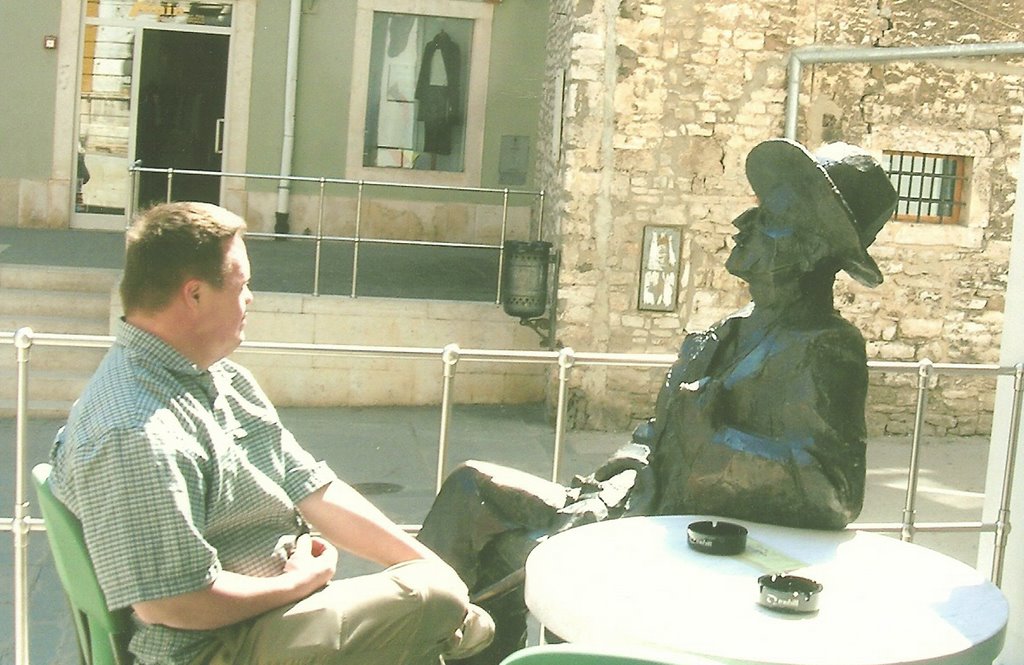
Follow signs for any real or fictional person. Or, you may just come upon one at a cafe. Here we found James Joyce, in Pula, Istria, Croatia - near the old Roman gate.

Spain. Ernest Hemingway was in Spain in the 1930's, among many other places. See www.timelesshemingway.com/thearoom/generalsec1. See the Hemingway post at
Spain Road Ways

France. Joan of Arc is over much of northern France. See www.archive.joan-of-arc.org; and
France Road Ways

Germany. The Brothers Grimm are centered in Germany. A fine museum is at Kassel. It was hard to find with our map, but we just parked finally, and walked through a large park rather than cope with one-way streets. The Brothers Grimm tales are the subject of www.nationalgeographic.com/grimm/index2. Our culture waters them down ridiculously. Are our children so fragile that they can't hear the real thing? I have an old Grimm from the late 1800's, early 1900's, and Rapunzel becomes "with child," the young man falls off the ladder and is blinded in the briars, she wanders int he wilderness and has twins, and ultimately they meet up again.

Rome. The Romans were over most of southern and central Europe. See www.bbc.co.uk/schools/romans/; and Germany Road Ways. They knew that it is one thing to conquer, another to administer afterwards, and they did both well - for centuries.

We also dogged these characters, real and fictional - using England as an example of all the springboards:

England. Robin Hood's legacy or compulsory sharing has spawned a New York City anti-poverty effort at www.robinhood.org/home/home.cfm. See character overview at www.boldoutlaw.com/.You can give your opinions at the Robin Hood Society at www.robinhood.ltd.uk/robinhood/index.

England. Find more about King Arthur at www.kingarthursknights.com/.

England. Charles Dickens? see www.helsinki.fi/kasv/nokol/dickens.

England. Chaucer - this site includes music at www.luminarium.org/medlit/chaucer.

England. Thomas a Becket. His life and murder at Canterbury Cathedral are described at www.eyewitnesstohistory.com/becket.

England. Peter Pan. Read the story version yourself at www.literature.org/authors/barrie-james-matthew/the-adventures-of-peter-pan/index.

Wales. And the castles regarding the Prince of Wales and Edward II in www.castlewales.com/caernarfon, and Wales Road Ways.

Scotland. There are Robert the Bruce, see www.magicdragon.com/Wallace/Bruce6. And
and William Wallace (Freedom!"); this site says it is getting at the truth: Wallace . The BBC also has a site: William Wallace overview

Nessie, see Loch Ness

and Rob Roy MacGregor in Scotland. See Rob Roy; Scotland Road Ways

Orkney, Ireland, Shakespeare. King Lot at Orkney. Early British Kingdoms

England and Scotland. Samuel Johnson at Dunvegan at Electric Scotland

The Huns, Huns. See the map of the migrations there. There are vestiges in Transylvania also. See Romania Road Ways

Everywhere. The Plague, www.themiddleages.net/plague.

Italy and France. Leonardo, www.mos.org/leonardo/bio.

England again. Dickens, www.online-literature.com/dickens/. Note to parents and teachers - educate yourself about what kind of term paper resource this is. I hadn't looked into them before. More traditional site is www.ontalink.com/literature/charlesdickens/index.

There will be plenty of signs for the other big sights as we go anywhere. We just don't focus on them. Sing whatever song you know about the place name or from the place as you go. Great for Paris and Ireland and Germany.

Brave people overcome: Marketgarden, Uskoks, Vinegar Hill, Templars, Heretics all over


Remember the overrun. Ours is a violent past. Look for this greed and power theme: Who lost out to history?

1. Operation Marketgarden, WWII in The Netherlands (A Bridge Too Far): Nijmegen and Arnhem. See www.rememberseptember44.com/. If the Allies had ultimately lost, what memorial would have lasted at these places for the people who died? History is told by the victors.

Is this true: Who gets in the books, and how, depends on the interest of the victor.

2. Croatia's Uskoks. Go to the city of Senj. See Croatia Road Ways That was an Uskok town, with their fortress at the top of the hill. I understand the Uskoks were refugees as the Turks pressed north and as the Ottoman Empire expanded on and on. The Uskoks settled at Senj and then assisted the Venetians and other Croatians against the Turks.

They were so successful, that the Turks were stopped, but then the Uskoks had to defend against their erstwhile allies, the Venetians, who turned against them, and ultimately demolished them. Greed and force.

3. Ireland and Vinegar Hill. See Ireland Road Ways Go up that hill, and feel how it was for farmboys with pitchforks to ascend against cannon. There is a statue in Wexford showing that. Vinegar Hill at least is remembered in folksong, however - remember Father Murphy. Next St. Patrick's Day. He was with the boys at Vinegar Hill, and was executed for it. Politics and force.

4. Here is a big one. The Knights Templar. Interest stems from seeing Templar castle, off on hill, inaccessible, Croatia. Misguided destruction; then the destruction of the destroyers. Tradition lives on. See the founding of the Knights Templar at users.1st.net/whitacre/templars. And at www.crystalinks.com/templars.

Find out for yourself what they did, what they learned and hid, if anything, and who did them in and why; and from as many sources as you can. Not just the movies or current novels.

Quotation attributed to St. Bernard of Clairvaux justifying Templar existence at the First Crusade by glorifying killing of non-Christians (in Berry, Steve, The Templar Legacy, Ballantine Books 2006 at p.353 (fiction):

"Neither dealing out death nor dying, when for Christ's sake, contains anything criminal but rather merits glorious reward. The soldier of Christ kills safely and dies the more sarely. Not without cause does he bear the sword. He is the instrument of God for the punishment of evildoers and for the defense of the just. When he kills evildoers it is not homicide,but malicide, and he is considered Christ's legal executioner."

Then the fate of the Templars themselves. Friday the 13th. Slaughter. Remnants? Great fun on internet.

Heretics. People who believed what they believed. See an overview of this concept of "heresy" at www2.kenyon.edu/Projects/Margin/heresy. Lions and tigers and bears? Ultimate issue seems to be the challenge to hierarchy. Gone.

Monday, July 31, 2006

Flags

Know the flag symbols and design before you go, and find out why they are as they are. There may be significant history there, and an excellent start for a conversation. Tell us about your flag.

There is a website on national flags, and how they came to be designed. See flags of the world at www.allstates-flag.com/. Click on the search menu at the top. Go to Serbia-Montenegro (Montenegro is now independent, however) and follow the clicks to its flag - a splendid double-headed gold eagle on a red ground.