 If Islamic studies, movements of culture in the Middle East, Eastern Europe, Central Europe, were not part of your schooling, go to this site for a map of the reach of early Islam - and ask why we teach as though the West is the compass point. Go to Historical Maps Overview, at Map, the Muslim World 814AD. Look at the size of Baghdad.
The roll of the Muslim territorial and religious expansion.
In no time at all, within 10 years, within a century, of the death of the Prophet in 621 AD. In that short span, the new religion had established itself firmly throughout and beyond the Arab lands of origin, and was still going, the rule then moving from the Arabs to include the Turks, and the Ottoman Empire taking over for centuries beating at Europe's doors. Europe, paying others to buffer for them (the Venetians hiring others in the Balkans, so Venice could be uninterrupted in its Empire building, for example), kept up its own religious arguments and internal and external persecutions, geneologies on thrones competing, but was there more that aided the Muslim expansion. This is not to downplay the commitment to belief that drove the movement, but to set it in a context.
Here, the Alhambra Palace, the Fountain of the Lions, at Grenada, Spain.
Black Death. Combined with local violence. Spain, Romania, the Balkans, accounts of battles against the Turks, the reign of Caliphs, what made Eastern and Central Europe so vulnerable. The role of disease and violence in history. The weakening that results, combined with lack of commitment to a relatively fixed belief system. There were differences persisting, and emerging conflicts between cultural social and religious justice-economic systems.
Here: A new book. It seems that the Black Death had a role in religious conquests as well as in other economic, social areas. Look at the speed and efficiency of the Muslim conquests after the death of the Prophet Mohammed.
To be read: "The Great Arab Conquests: How the Spread of Islam Changed the World We Live In," by Hugh Kennedy, Middleast Correspondent, The Economist, Da Cap Press 2007, see International Herald Tribune, at ://www.iht.com/articles/2008/01/04/arts/idbriefs5H.php; Steve Goddard's HistoryWire at ://www.historywire.com/2008/01/book-alert-th-1.html. Highlights from the NYT review by Max Rodenbeck:
1. Chronology provided: Unity and focus of Islam's faith, one text, virtually immediately upon the death of the Prophet Mohammed. Compare to Christianity 10-100 years after the death of Jesus, where people were still arguing over what should be in the Bible or not, "canonized" - see ://gbgm-umc.org/UMW/bible/cea.stm; in the fourth century or so; and still are discussing what happened there; and an additioal current topic - how do later writings relate, see ://www.jefflindsay.com/BOMIntro.shtml.
- 632 AD: death of the Prophet Mohammed
- By 647 AD: followers had "erased" Persia, decimated Byzantium's power, extended an empire's reach "as vast as that of Rome at its height.
- By 732 AD: Muslim armies had reached China to the East, extended 5000 miles to the West, and "had charged across Spain to clash with the Merovingian princes of what is now France."
2. Scope
Military; one faith, uprooting local religions (Zoroastrianism, Buddhism, Hinduism); severing of "1000 year old links" that had bound south and north Mediterranean areas; linguistic - Arabic supplanted Latin and Greek as main conduit, "repository of human knowledge."
3. Factors primarily identified include:
Timing. "Exploitation of weakness." Plague had reduced populations in Near East and Mediterranean. "Political Turmoil" left Byzantium and Persia profoundly weakened. Areas were unprepared to counter the Muslim attacks.
Christianity was fractured - many Egyptians and Syrians sided with the Arabs against the Byzantines. Byzantines had tried to use force to convert. Muslims were more lenient, in many areas, allowing other worship, without onerous conditions (in many areas, not all). However, resistance could also be met with destruction in others.
4. Double fronts. Arab strength at outset, Turkish strength later in pushes through Balkans, East Indies, Spain. Then, stability of borders, after further upheavals several centuries later, once Spain was reconquered, and Turkish Muslims pushed back from Balkans, East Indies.
Mainly used in the book = texts, rather than archeological evidence, but we are not sure quite what that means. Waiting for the book at the library.


 Black Madonna, Church of St. Mary, Gdansk, Poland
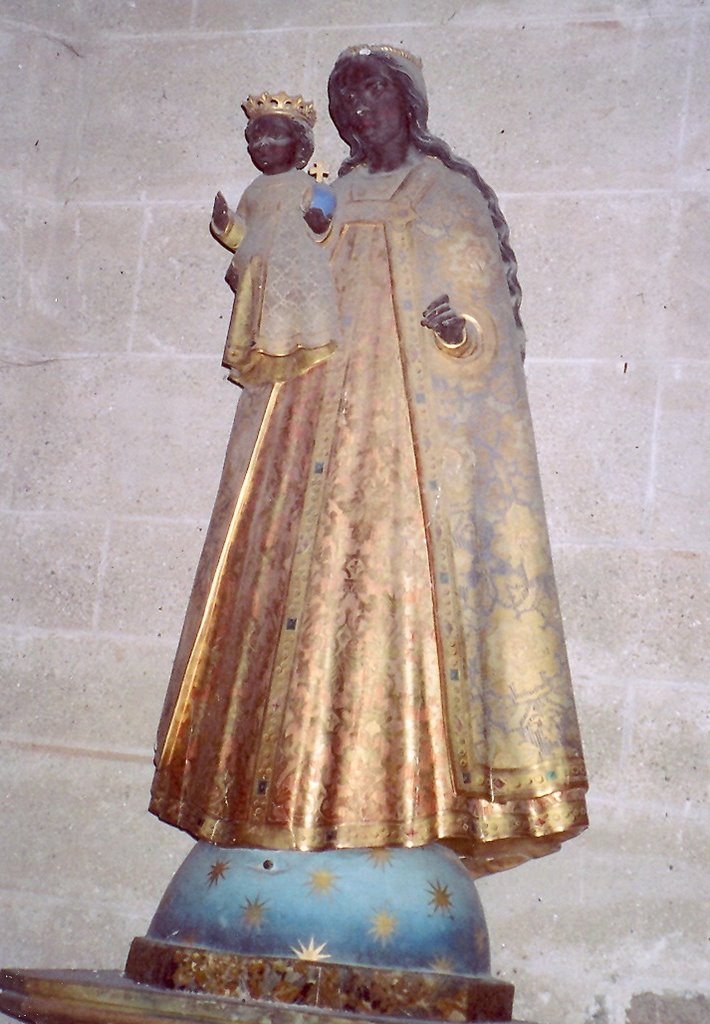 Black Madonna, Mont St. Michel, France
 Black Madonna, Altotting, Germany
 Black Madonna, Wroclaw, Poland (copy of Jasna Gora?)
 Black Madonna, St. Mary's Church, Gdansk, Poland (copy of Jasna Gora)