Finding Black Madonnas
As we find more, we add: Black Madonna at Maria Plain, Salzburg, Austria, at
Austria Road Ways, Maria Plain, Black Madonna? As I recall, there was also a copy at Maria Plain of the Jasna Gora Black Madonna. Someone go back. Also visit Mariazell, Austria. Note that this site does not even mention she is black, at
http://www.sacred-destinations.com/austria/mariazell-shrine
For our older list of Black Madonnas:
1. Gdansk, Poland
 Black Madonna, Church of St. Mary, Gdansk, Poland
Black Madonna at the Church of Saint Mary, Gdansk, Poland. There as another Black Madonna at that Church, that looks like a copy of the Black Madonna at Jasna Gora Monastery, also in Poland.
No further information yet.
Note that this may not be a Black
Madonna" because there is no child. The inscription looks like a Russian reference, by the script - but we are not expert on that. See
Poland Road Ways.
2. Mont St. Michel, France
/
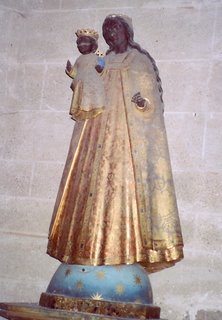 Black Madonna, Mont St. Michel, France
Black Madonnas are found throughout Europe, and seem to date from the early middle ages, mostly. Some may be earlier, and the legends and stories explaining them are varied.
For a background for these, and where they are, black virgin statues at www.ancientquest.com/embark/blackvirgin; and Eann Begg's at www.udayton.edu/mary/resources/blackm/blackm.
.
There is a theory to fit each person's predisposition as to why. No one explanation fits them all. See saxakali.com/suzar/madonna, for a history of black madonnas.
Here is the Black Madonna at Mont St. Michel, France. See if you agree that our western religious orientation is to downplay the role of the black, and lands connected to our Bible that were in Africa, see
Martin Luther's Stove, Translation Serving a Cultural Agenda.
See also ://www.udayton.edu/mary/resources/blackm/blackm.
3. Altotting, Germany
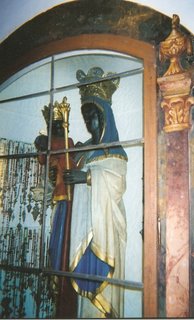 Black Madonna, Altotting, Germany
.
This is the Black Madonna at Altotting, Germany.
.
We also saw another Black Madonna at Guadalupe, Spain. This was a tiny triangular shaped Madonna with a tinier head, very high up, and with a multitude of costumes on display that change with the seasons and feast days.
These places are usually also pilgrimage destinations. Another site names another black madonna at Altotting, see the small A-shape, doll-like form that appears in many places, at ://romanmiscellany.blogspot.com/2006/09/alttting.html/ The explanation there is that her face is darkened by the centuries - but somehow the face of the child remains light.
4. Jasna Gora, Czechestochowa, Poland; and Wroclaw Poland
 Black Madonna, Wroclaw, Poland (copy of Jasna Gora?)
.
This is the Black Madonna at Wroclaw, Poland, apparently a copy of the original at Czestochowa, Jasna Gora Monastery, Poland. Do an "images" search for Black Madonna, Jasna Gora, and see the similarities - no photos were permitted of it.
See discussion re the broadly different representation of the Black Madonna in the Jasna Gora gift shop (different dress, and elaborate crowns, and varying skin tones available for purchase, including pale Caucasian white), at
Poland Road Ways.
No one explanation fits all the Madonnas. Some charred, others originally black, others buried. This source presents the thesis that white madonnas were later in time than the black madonnas. Some find African origins. See www.africanbynature.com/links/madonnalinks.
.
Here is a picture of the small and high on the wall Black Madonna at Guadalupe, Spain. Too high for a good picture using my camera: See www.solt3.org/guadalupespain/.
5. Copy of Jasna Gora at Gdansk, Poland
 Black Madonna, St. Mary's Church, Gdansk, Poland (copy of Jasna Gora)
Here is a copy of the Jasna Gora Black Madonna at Gdansk, Poland, also showing the same kind of clothing as at Wroclaw.
Even the "images" search shows some versions with the crowns and different dress, and I can't remember the original any more. I thought I was buying a picture of it, but apparently not. Someone go check it out?
This is a different concept from the "inculturated" black madonnas that reflect a cultural depiction, so that there would also be madonnas with the facial features and skin tones of the people whose conversion is sought; or ones with features like those of the faithful in the area. See www.udayton.edu/mary/meditations/blackmdn. What color was Mary? Or Jesus? What does it say about us, that we have to ask?
See this site for connections to pagan black goddesses, see crystalinks.com/blackisis.
I looked up official images of Mary at this site, catholic-forum.com/saints/saintbvm, but found none of the Black Madonnas.


 Black Madonna, Church of St. Mary, Gdansk, Poland
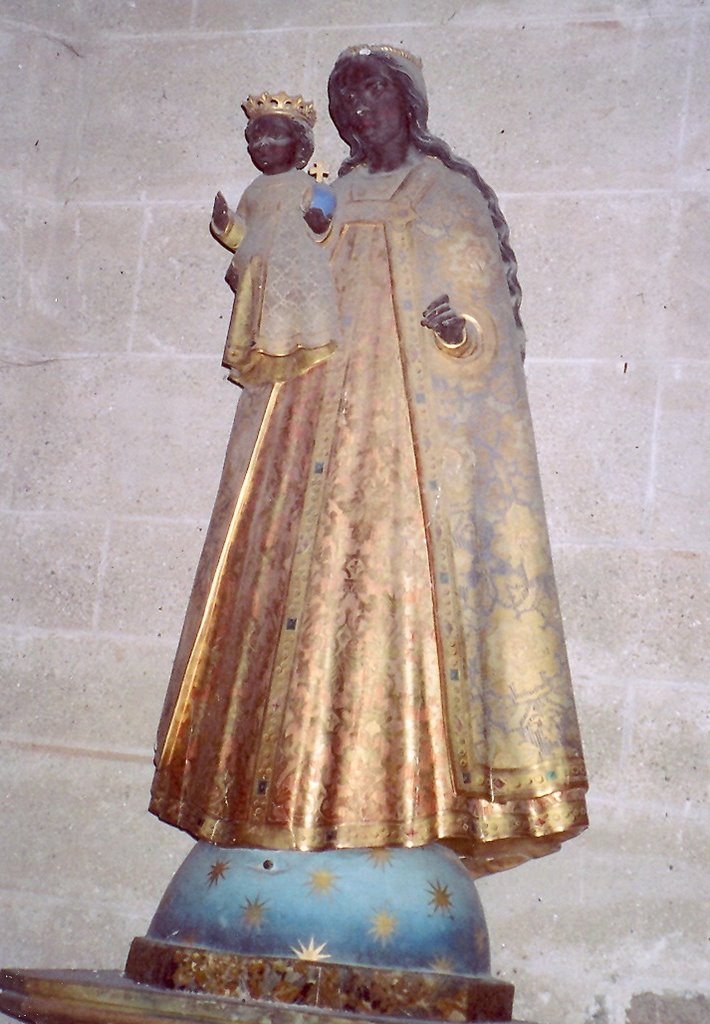 Black Madonna, Mont St. Michel, France
 Black Madonna, Altotting, Germany
 Black Madonna, Wroclaw, Poland (copy of Jasna Gora?)
 Black Madonna, St. Mary's Church, Gdansk, Poland (copy of Jasna Gora)