Sunday, January 20, 2008

Muslim Conquests - Expansion Theme, and Context

If Islamic studies, movements of culture in the Middle East, Eastern Europe, Central Europe, were not part of your schooling, go to this site for a map of the reach of early Islam - and ask why we teach as though the West is the compass point. Go to Historical Maps Overview, at Map, the Muslim World 814AD. Look at the size of Baghdad.

The roll of the Muslim territorial and religious expansion.

In no time at all, within 10 years, within a century, of the death of the Prophet in 621 AD. In that short span, the new religion had established itself firmly throughout and beyond the Arab lands of origin, and was still going, the rule then moving from the Arabs to include the Turks, and the Ottoman Empire taking over for centuries beating at Europe's doors. Europe, paying others to buffer for them (the Venetians hiring others in the Balkans, so Venice could be uninterrupted in its Empire building, for example), kept up its own religious arguments and internal and external persecutions, geneologies on thrones competing, but was there more that aided the Muslim expansion. This is not to downplay the commitment to belief that drove the movement, but to set it in a context.

Here, the Alhambra Palace, the Fountain of the Lions, at Grenada, Spain.

Black Death. Combined with local violence. Spain, Romania, the Balkans, accounts of battles against the Turks, the reign of Caliphs, what made Eastern and Central Europe so vulnerable. The role of disease and violence in history. The weakening that results, combined with lack of commitment to a relatively fixed belief system. There were differences persisting, and emerging conflicts between cultural social and religious justice-economic systems.

Here: A new book. It seems that the Black Death had a role in religious conquests as well as in other economic, social areas. Look at the speed and efficiency of the Muslim conquests after the death of the Prophet Mohammed.

To be read: "The Great Arab Conquests: How the Spread of Islam Changed the World We Live In," by Hugh Kennedy, Middleast Correspondent, The Economist, Da Cap Press 2007, see International Herald Tribune, at ://www.iht.com/articles/2008/01/04/arts/idbriefs5H.php; Steve Goddard's HistoryWire at ://www.historywire.com/2008/01/book-alert-th-1.html. Highlights from the NYT review by Max Rodenbeck:

1. Chronology provided: Unity and focus of Islam's faith, one text, virtually immediately upon the death of the Prophet Mohammed. Compare to Christianity 10-100 years after the death of Jesus, where people were still arguing over what should be in the Bible or not, "canonized" - see ://gbgm-umc.org/UMW/bible/cea.stm; in the fourth century or so; and still are discussing what happened there; and an additioal current topic - how do later writings relate, see ://www.jefflindsay.com/BOMIntro.shtml.

  • 632 AD: death of the Prophet Mohammed
  • By 647 AD: followers had "erased" Persia, decimated Byzantium's power, extended an empire's reach "as vast as that of Rome at its height.
  • By 732 AD: Muslim armies had reached China to the East, extended 5000 miles to the West, and "had charged across Spain to clash with the Merovingian princes of what is now France."

2. Scope

Military; one faith, uprooting local religions (Zoroastrianism, Buddhism, Hinduism); severing of "1000 year old links" that had bound south and north Mediterranean areas; linguistic - Arabic supplanted Latin and Greek as main conduit, "repository of human knowledge."

3. Factors primarily identified include:

Timing. "Exploitation of weakness." Plague had reduced populations in Near East and Mediterranean. "Political Turmoil" left Byzantium and Persia profoundly weakened. Areas were unprepared to counter the Muslim attacks.

Christianity was fractured - many Egyptians and Syrians sided with the Arabs against the Byzantines. Byzantines had tried to use force to convert. Muslims were more lenient, in many areas, allowing other worship, without onerous conditions (in many areas, not all). However, resistance could also be met with destruction in others.

4. Double fronts. Arab strength at outset, Turkish strength later in pushes through Balkans, East Indies, Spain. Then, stability of borders, after further upheavals several centuries later, once Spain was reconquered, and Turkish Muslims pushed back from Balkans, East Indies.

Mainly used in the book = texts, rather than archeological evidence, but we are not sure quite what that means. Waiting for the book at the library.

Saturday, January 19, 2008

Wednesday, January 16, 2008

Rip-offs. Currency Conversion, Fees. The Commonest Themes of All

1. Hotel rip off. We expect the big hotels to bill fees off the wall, especially for parking, valet. Sometimes we stay there in a pinch because we are tired, lost, the streets all go the wrong way, and the four-star is right there when you need it, as in Bucharest, Romania. Just expect it, and pay your bill each morning so they do not add up, and so you can move out if need be.

2. Currency conversion. How you pay counts.

2.1 Check your fees in advance. We do not expect the US of A to do it to us, but credit card companies do anyway. We just got a notice of a class action suit against, among others, Mastercard and Visa, for hidden fees for exchanges of currency. Yes. You get home and lose your teeth as you mouth drops open. This is for a settlement, no trial, but watch your mail and apply for it. Maybe we get enough for another trip!

2.2 Without Amex traveler's checks any more, watch out for prepaid cards. Say at AAA (bless their hearts), you put in so much money and expect to be able to draw on it, but you may get a 7% surcharge. Your own credit card may only charge 1%. See NYT 10/21/2007 - even Rick Steves, the travel guru, says to get your advance payments in Euro before you go.

Do use AAA for some of the country's currency before you go. Like yeast. Don't land with nothing; or cross any border without some seed money.

2.3 Mastercard and Visa may charge 1% of the purchase price. The article says that, if the euro is 1 and dollars are at $1.40, a 1% would show as another $1.40. At 3% surcharge, you get hit for $4.20.

Look for the 1% deals and read the fine print. Go to www.bankrate.com/currencyconversion. Do not let anybody convert to dollars when you are there - big surcharges.

2.4 ATM. We use those all the time. Make your $200 per day if need be. But check your own bank for charges. Tell your card people that you are traveling and where because they may freeze your card if odd locations appear. Our card number was stolen in Romania, and thanks to Farmington Savings Bank, they froze the card when new charges appeared six months later, and before before there was a loss.I think it was the fancy hotel. Ha.

Wednesday, December 12, 2007

Roma origin of a "Black Madonna" ? - and Sara the Black, Sara-la-Kali

The Black Madonnas are in many European and other countries, see overall post here at Europe Road Ways, Black Madonnas. We thought we found one here, in Gdansk Cathedral, Poland.

I assumed it to be another wonderful Black Madonna, but there is no baby. Checking, and do follow the path at Bogomilia, A Site for the Unsung, Sara the Black, this does appear to be Sara the Black, so far.

Now to go back to other Black Madonnas to see which may also be the Gypsy Sara the Black. Start with Wikipedia on this - at ://en.wikipedia.org/wiki/Saint_Sarah . Find the stories. An Egyptian servant to Mary in Egypt? Other stories? Here is information about an annual pilgrimage of Roma in France, homage to a Sara the Black, see //www.geocities.com/~Patrin/stsm01.htm.

If you look at the crescent here, then at the symbol for Gitans at the website, that also includes a crescent, perhaps you know where to look to see if there is a connection. The crescent also can relate to early two-horned moon symbols, or Mithra's horns, from the bull overcome by Mithra - Mithraism being the dominant religion before Christianity (Mithra ascended after his death in about 200AD?) see //www.mysteriousbritain.co.uk/gods&goddesses/mithra.html. See also Bogomilia, A Site for the Unsung, Sara the Black, for more on Mithraism. Do not go to these places if you do not like finding roots.

Apparently the first historical reference dates to 1521, hand-written legends are located at Arles, and she has long been the patron of the Gypsies. There are many stories of her origins and works, including that she accompanied the Two Maries to the tomb and found it empty, and she also announced that event. Or, she was a black servant, and so many versions - go read.

The destination church for the annual May pilgrimage is Saintes-Maries de la Mer. This is a start. A new direction for us in understanding these wonderful paintings and sculptures.

Saturday, November 17, 2007

Gypsies, Roma, Romani, Romni, Romney


Where to start with this complex topic. Roma appear in most of Eastern and Western Europe, migrated as did any other group to places from Australia to the United States, show physical characteristics tying them to India, perhaps, and linguistic commonalities also stemming from there.

Here, street musicians in Warsaw (not Dan, on the right, however). See them in horsecarts in Romania, scavenging in dumps there, going with great style into a casino, or watching from a dark doorway as hordes of little children clamber over your car, little fingers reaching, until finally you go, "Whtjshhhht!" With your own hands scissoring fast across each other horizontally, "Whjthshhhhstht!" No more. And the adult calls them back, Dan gets out, stays by the car to see no little one is under a tire, and we creep back out, wave a thank you, Dan pops back in and off.

See our site at Gypsies, Roma, Romani and "Zoli", by Collum McCann, a novel based roughly on the life of the Gypsy poet Branislawa Wajs. Read his book, "Zoli," for a view of the Slovakian -Polish experience 1920's-1980's or so.

Then read, "Bury Me Standing, The Gypsies and Their Journey," by Isabel Fonseca, Alfred A. Knopf NY 1995. Ms. Fonseca lived with various Gypsies and in Gypsy communities. Then let it all steep, because there is so much to try to grasp. They have survived.

And look at the surnames. We all may have some in us. Romney, Rom'ni, the names referring to smiths, blacksmiths, coopers, coopersmiths, on and on. Different groups specializing in different trades, music.

And the slaughter, the prejudice. Focus on that. We have gotten nowhere. Sites for these issues are in the Gypsies Roma site.

Saturday, September 15, 2007

Plague -Plague Columns - Marian Columns - Mary the Protector

In Eastern and Central Europe, supplications against recurrence of Plague, and gratitude for deliverance, take the form of Marian Columns in many towns, or Plague Columns. In the Czech Republic, there was a particularly virulent epidemic in about 1680, that led to many towns constructing in about 1715 these Plague or Marian, Columns. Here, at Kutna Hora, in the Czech Republic, see Mary at the top with her crown of stars, and the piles of shapes beneath, leading up like so many agonizing buboes, to where she finally rests. See Czech Republic Road Ways. Read about this town in the Czech Republic that lists its Marian Column. //www.zamekvranov.cz/screen.php?str=pamatky_obce_vranov&jazyk=en. Or, see its extreme form - almost ugly in its representation of lump-like pustules, at Olomuc, CZ. Do your own Images search for Olomouc Marian Column.

How did Mary arise to this position, as somehow a safety source from death? No direct answer, but some religious groups give roundabout ones: www.virtualmuseum.ca/Exhibitions/Annodomini/THEME_11/EN/theme11-7. It looks like when it comes down to absolute devastation, a goddess figure works better. Theologians among us?


How humans react to unfathomable disaster. There are many fountains and other kinds of memorials to the era of the Black Death, and how people tried to expiate whatever forces were bringing it on again and again. There were at least three forms of it.

This fountain showing death, disease and suffering from the Plague I believe was in Oberammergau, Germany, or perhaps Garmisch.

A familiar memorial and way to keep the Plague from coming again is the pledge to act a play out in Oberammergau, Germany, every ten years. The next will be in 2010. See www.neuschwanstein-country.net/hotels/Oberammergau/en-oberam. Other sources:
www3.iath.virginia.edu/osheim/intro.

The Plague affected politics, culture, religion, society. See also "The Black Death, Natural and Human Disaster in Medieval Europe" by Robert S. Gottfried, The Free Press, 1983.

One site focuses on the specific outbreak 1347-1350, and focuses on the rat infestation and rats as carriers of the fleas that passed on the Plague, see www.insecta-inspecta.com/fleas/bdeath/.

Climate change - attention, out there - can also be dispositive in how a disease spreads. Other sources say it was not just the rodent infection. That combined with climate change 1050-1347, to extreme cold and wet; then add the movements west of the Huns and others from the East, carrying Plague from where Plague seems to have originated in conditions there, and the carrying of it from port to port. Then, a period of respite, perhaps 8-10 years, maybe more, and it came again. The sick rats died, the survivors began to reproduce again, the infection was still being fostered by the climate and other conditions, and it began again. And again.

Over a hundred years. 1350-1500. Enormous and repetitive depopulation. Overall perhaps a third of the European population died. In each bout, maybe 10% here, 30% there, 50% somewhere else, and then it all began again in differing proportions. And smallpox, measles.

But many modern medicine and religious and literature ideas began with coping with Plague, as did great social and economic change. Bubonic Plague. The Plague. The Black Death.

For more general info, see www.themiddleages.net/plague.

Tuesday, September 11, 2007

Black Madonnas: Medieval (and earlier); early pagan roots?

Finding Black Madonnas

As we find more, we add:  Black Madonna at Maria Plain, Salzburg, Austria, at Austria Road Ways, Maria Plain, Black Madonna? As I recall, there was also a copy at Maria Plain of the Jasna Gora Black Madonna.  Someone go back. Also visit Mariazell, Austria. Note that this site does not even mention she is black, at http://www.sacred-destinations.com/austria/mariazell-shrine

For our older list of Black Madonnas:

1.  Gdansk, Poland

Black Madonna, Church of St. Mary, Gdansk, Poland
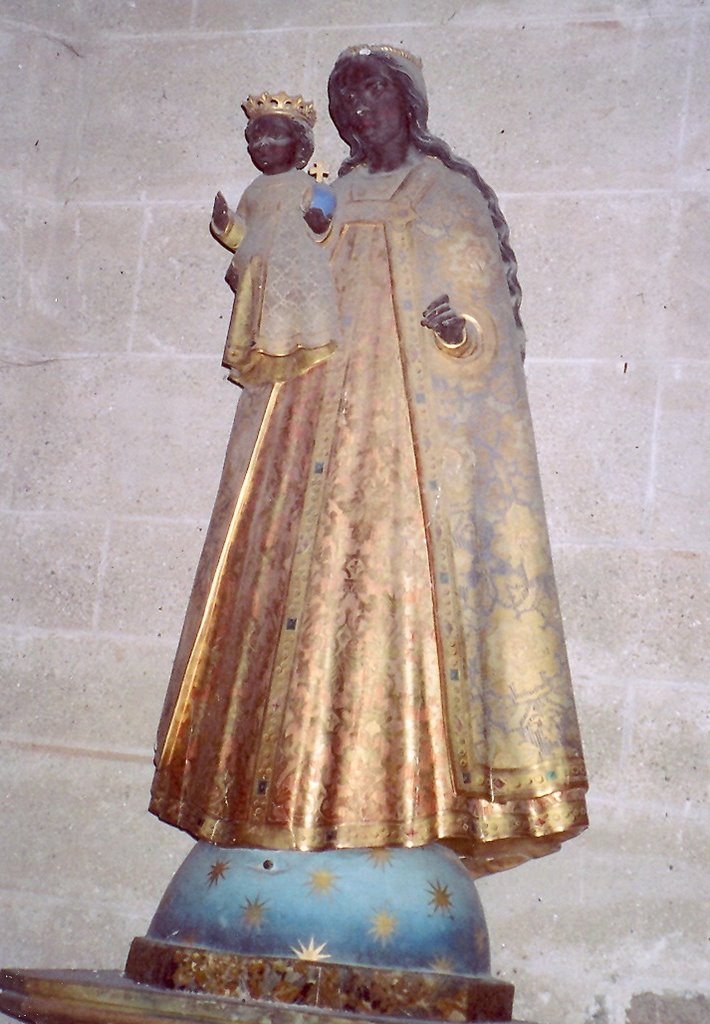
Black Madonna at the Church of Saint Mary, Gdansk, Poland. There as another Black Madonna at that Church, that looks like a copy of the Black Madonna at Jasna Gora Monastery, also in Poland.

No further information yet.

Note that this may not be a Black
Madonna" because there is no child. The inscription looks like a Russian reference, by the script - but we are not expert on that.  See Poland Road Ways.

2. Mont St. Michel, France
/
Black Madonna, Mont St. Michel, France

Black Madonnas are found throughout Europe, and seem to date from the early middle ages, mostly. Some may be earlier, and the legends and stories explaining them are varied.

For a background for these, and where they are, black virgin statues at www.ancientquest.com/embark/blackvirgin; and Eann Begg's at www.udayton.edu/mary/resources/blackm/blackm.
.
There is a theory to fit each person's predisposition as to why. No one explanation fits them all. See saxakali.com/suzar/madonna, for a history of black madonnas.

Here is the Black Madonna at Mont St. Michel, France. See if you agree that our western religious orientation is to downplay the role of the black, and lands connected to our Bible that were in Africa, see Martin Luther's Stove, Translation Serving a Cultural Agenda.

See also ://www.udayton.edu/mary/resources/blackm/blackm.

3.  Altotting, Germany

Black Madonna, Altotting, Germany
.
This is the Black Madonna at Altotting, Germany.
.
We also saw another Black Madonna at Guadalupe, Spain. This was a tiny triangular shaped Madonna with a tinier head, very high up, and with a multitude of costumes on display that change with the seasons and feast days.

These places are usually also pilgrimage destinations.  Another site names another black madonna at Altotting, see the small A-shape, doll-like form that appears in many places, at ://romanmiscellany.blogspot.com/2006/09/alttting.html/  The explanation there is that her face is darkened by the centuries - but somehow the face of the child remains light. 


4.  Jasna Gora, Czechestochowa, Poland; and Wroclaw Poland

Black Madonna, Wroclaw, Poland (copy of Jasna Gora?)
.
This is the Black Madonna at Wroclaw, Poland, apparently a copy of the original at Czestochowa, Jasna Gora Monastery, Poland. Do an "images" search for Black Madonna, Jasna Gora, and see the similarities - no photos were permitted of it.

See discussion re the broadly different representation of the Black Madonna in the Jasna Gora gift shop (different dress, and elaborate crowns, and varying skin tones available for purchase, including pale Caucasian white), at Poland Road Ways.

No one explanation fits all the Madonnas. Some charred, others originally black, others buried. This source presents the thesis that white madonnas were later in time than the black madonnas. Some find African origins. See www.africanbynature.com/links/madonnalinks.
.
Here is a picture of the small and high on the wall Black Madonna at Guadalupe, Spain. Too high for a good picture using my camera: See www.solt3.org/guadalupespain/.

5. Copy of Jasna Gora at Gdansk, Poland

Black Madonna, St. Mary's Church, Gdansk, Poland (copy of Jasna Gora)

Here is a copy of the Jasna Gora Black Madonna at Gdansk, Poland, also showing the same kind of clothing as at Wroclaw.

Even the "images" search shows some versions with the crowns and different dress, and I can't remember the original any more. I thought I was buying a picture of it, but apparently not. Someone go check it out?

This is a different concept from the "inculturated" black madonnas that reflect a cultural depiction, so that there would also be madonnas with the facial features and skin tones of the people whose conversion is sought; or ones with features like those of the faithful in the area. See www.udayton.edu/mary/meditations/blackmdn. What color was Mary? Or Jesus? What does it say about us, that we have to ask?

See this site for connections to pagan black goddesses, see crystalinks.com/blackisis.

I looked up official images of Mary at this site, catholic-forum.com/saints/saintbvm, but found none of the Black Madonnas.

Wednesday, August 29, 2007

How We Bury Our Dead - Cemeteries, Charnel Houses, and Roots


1. Czech Republic and Poland. Some people were buried in mass graves, then disinterred and the remains put in Charnel houses for reasons including the overwhelm of epidemic, or war.
For Charnel Houses relating to Plague or the Thirty Years' War (early 1600's) see post for the walled church near Kutna Hora CZ, window view shown here, at Czech Republic Road Ways.

See also the post for Kudowa Zdroj at Poland Road Ways. More graphic. No filming was allowed inside; the view there is also
from the outside windows.

We did not visit the monastery at Sedlec, near Kutna Hora CZ where the bones were made into chandeliers and other decorative objects - sconces, etc. Not just lack of time, but also we liked our quiet times at these places and didn't want death with bling. See it here: www.discoverczech.com/multimedia-gallery/picture-detail.php4?obrazek=500600; or do a simple Images search for Sedlec. Forty thousand people in parts for your illumination.

2. Romania. Some graves are hauntingly colorful. Here is the Merry Cemetery in Romania, in Sapinta in the northwestern section near Ukraine.

A woodcarver in the 1930's, I believe, began memorializing people's lives and how they died on their wooden markers. The tradition continues. One here shows, as affirmed by an English-speaking Romanian nearby, a man being shot by a firing squad, or patrol of Germans. See more at Romania Road Ways. Other carvings show butchers, housewives, bed-ridden people, smiling people, children with a car coming at them, stories all.

3. Ireland. Some graves are close to roots. This one is in Ireland, in the middle of someone's commercial opportunity, a monastery ruin in the middle of a golf course.


4. France. An admirer still leaves flowers for WWII singer Edith Piaf at Pere Lachaise cemetery in Paris.


More France: Here, at the Ossuary at Verdun, from the campaign 1916-1917, are the various remains of some 150,000 unknown soldiers, German and French, Moroccan, Foreign Legion. They are beneath a central spiral in this large memorial, names lining the bays. See World War. This is an original old postcard of ours, a very small collection from Verdun, no date (unused) but very yellowed, with French captioning.


5. Croatia. And here, a photograph shows us just who this individual 16-year old Terezija was, in Croatia, and she is ever reading.


6. Bosnia. In some places, graves are cast off.

Here, a graveyard and a road runs through it. Graveyard, Bogomils, old Christian sect 9th-12th Centuries, killed off by the self-proclaimed true church, Bosnia. See history at www.nationsencyclopedia.com/Europe/Bosnia-and-Herzegovina-HISTORY. Start wiath the home page at the dot com, then move to the specifics if you can.

7. Ireland. Some graves witness specific tragic eras. Famine cemetery, Skibbereen, Ireland.


8. Luxembourg. Some graves seem like an anticlimax, given the publicity given to the person elsewhere.

The great WWII General Patton is buried off in Luxembourg, but is better known for his campaigns elsewhere. He is at the US Military Cemetery at Hamm, Luxembourg. He lies facing his 7-8,000 troops, though. We got here just in time to help with the flag. so far away. Not many Americans do come here, I understand. Excellent. Attention should be paid.

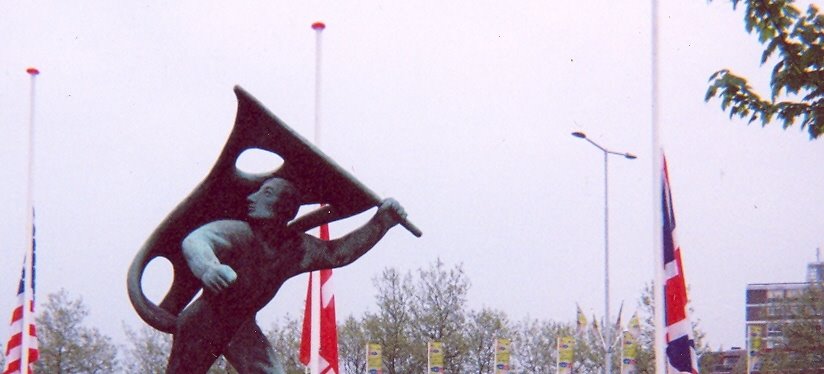
8. The Netherlands. Some graves are remembered with vast speeches and memorial days. Here, festive remembrance. VE Day parade, Nijmegen, The Netherlands. The "A Bridge Too Far" bridge is just north, at Arnhem. Nijmegen's bridge is where Americans fought, I understand, as part of Operation Market Garden.


9. Germany. Some graves are mass graves, preserving where huge numbers of people perished.


See Buchenwald Concentration Camp, near Weimar, Germany. See the stones for remembrance, and other cultural-practical roots, at this ground headstone at Buchnwald, Germany. Nearby is the little bear pit, a dear child size zoo thing, where the Nazi's children and families, and any assigned "help," would sit and play and watch the bears while the inmates were just beyond, behind the barbed wire fence over there.

10. France. Here, battlefield at Vimy Ridge, France. Trenches, craters and hills showing where uprooted trees fell, or blasts. WWI. Area cannot be easily mowed, so sheep safely graze there. There are often large ossuaries at WWI grave areas. Fragments so small.


11. Arras, France. Some graves are pocket-size, especially from WWI, where you can find a family member. Here is our grave of relative Lt. Col. Maurice McConaghey, Royal Scots Fusiliers 1917, WWI, Arras, France. See post in WWI Finding Graves.


12. Belgium. Some graves have huge monuments.
Remembering with monuments. Canadian Memorial, Ypres, Belgium, WWI. Uncle Len was there. He was in the Canadian forces, gassed, but survived.


13. Belgium. And the American Memorial, Bastogne, Belgium (WWII). Such admiration and gratitude for the
American soldiers' efforts and heroism here. This - the idea that you are doing good after all - is a legacy that our leaders today are taking from our soldiers, I think.


14. Croatia. Some graves are in large grand mausoleums. See the formal cemeteries at Miragoj Cemetery, Zagreb, Croatia: Orthodox Christians, Roman Catholics, and carefully alphabetized and birth-death dates and names of German soldiers, WWII.


15. Croatia. Some graves are virtually forgotten. Here is Jasenovac Concentration Camp site, 1940's, Croatia: The dead here are not only Nazi-targeted groups, but Orthodox Christians, numbers vary 60,000-600,000. Belongings and photos now at Holocaust Museum, Washington, DC. Everything closed up, broken here. Where do families go to find their people?


16. Montenegro. Some graves become rallying points. Here, a firing squad memorial in Montenegro (Cetinje).


17. To find graves, try Geneology sites: www.myheritageresearch.com/. This one uses over 400 sources, including world cemetery regords; and www.familysearch.org/; good for using American and Canadian census materials, death indexes and some marriage and birth records; and www.ancestry.com/. This one includes military records, court, land and some probate records for US, and some UK census. And www.legacy.com/. This has some 5 million recent and old obituaries, daily newspapers, past 6 years only, I think. Check. These overviews are from the Wall Street Journal of June 22, 2006.

18. United States. Some reflect the personality of the person beneath. See an all-American attitude veteran's grave, at Saratoga, NY:


...................................................................................

Cemeteries are for the living, says Jay Walljasper in his book, "The Great Neighborhood Book," New Society Publishers 2007. See him at www.pps.org/info/aboutpps/staff/jwalljasper. Return to them as parks, attractions, for picnics.

There is also a cemetery preservationist at the Connecticut Gravestone Network, Ruth Shapleigh-Brown, see www.ctgravestones.com/Contact_info. who helps with the finding.

Resources:

1. Site for finding overviews of whatever country your people may have come from: www.everyculture.com/multi/index. Overview, Country and Culture.

2. Site for finding graves of famous, infamous and not famous people: www.findagrave.com/index.

Wednesday, August 15, 2007

Architecture - Gehry and Gehry-type wavy buildings and other Whimsy

Frank O. Gehry, American architect, and his legacy worldwide. Here is the art museum at Bilbao, Spain, see Spain Road Ways.


This fine dragonfly is affixed to a building in Prague, recalling Franz Kafka's character who woke up to find he had morphed to a giant insect.
See Czech Republic Road Ways.
There are other figures and bugs affixed to buildings in Munich and other German cities.

The Dancing House - Fred and Ginger - also in Prague.

See it at pragueexperience.com/places.asp?PlaceID=651. Architects Vlado Milunk and American Frank O. Gehry. Better yet, just search Images for Dancing House.

Crazy house at Sopot, Poland.

See www.flickr.com/photos/sebarave/13073110/. Or do that famous Images search for Sopot house.

Saturday, August 11, 2007

Holocaust, Petr Ginz, and other war diaries, children and adult

War diaries. Holocaust diaries.

1. The Netherlands:

Anne Frank, in hiding and focusing (for lack of other sensory stimulation) on her interior life, see www.ushmm.org/museum/exhibit/online/af/htmlsite/; and Etty Hillesum, a young woman in her 20's and the perspective of an unmarried adult. See en.wikipedia.org/wiki/Etty_Hillesum; www.quotationspage.com/quotes/Etty_Hillesum/. See Netherlands Road Ways;

2. Bosnia:

Zlata Filipovic was 11 when her world began to fall apart. She wrote a journal from Sarajevo. More on Zlata at mv.com/Writers-Corner/EVENTS/zlata. She had moved from Bosnia, and was in Paris by 1995. This is a chat session, with schoolchildren. You can also look her up in Wikipedia, search for her name there. Her family survived.

3. Lebanon.

See article in the New York Times, by Tom Zeller, Jr., on July 24, 2006, re a girl who videotaped her escape down the stairs to a shelter during bombing. Her name is Galya Daube. Then there is Finkployd at BloggingBeirut.com.

4. The Czech Republic, then Czechoslovakia:

"The Diary of Petr Ginz 1841-1942," edited by his sister, Chava Pressburger, the diaries logging events in this 12-14 year-old's life in Prague, then he was sent to Theresienstadt, then killed at Auschwitz. See The Places of Petr Ginz; and Czech Republic Road Ways.

5. Poland

"Rutka's Notebook," 1943, Rutka Laskier from Bedzin, Poland. She kept a diary for several months, then was sent to Auschwitz where she died. www1.yadvashem.org/research_publications/temp_publications/temp_index_Rutkas_Notebook.html